Posts

Changing Fires Mean Changing Forests
Image
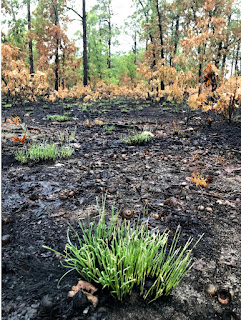
Blog By: Grace McLeod Check out  Contributing Bloggers  for Bio Figure 1: Early regeneration just two weeks after a wildfire. Photo: Grace McLeod Standing under the towering pines, it's hard to believe there was a wildfire here just a couple weeks ago. The needles of the lower tree branches are scorched brown, and the smell of wet charcoal sits heavy in the humid air after last night's rain, but the black ground is scattered with tufts of bright green grass almost as tall as my ash-scuffed boots. It’s amazing how fast fire-dependent ecosystems start to recover! The pine forests of the southeastern US have evolved with frequent fire (Figure 1). Many of the species of plants and animals depend on the regular disturbance, and without it, the open pine forests, which are highly endangered and host incredible biodiversity, will start to change to denser, more hardwood dominated systems.  I talk to people all the time who have lived in Florida their whole lives and had no ide...

The "Bad Guy" in the Everglades

Image
        If you were to name some good things about wetlands, what would you say? Maybe you would mention their role in climate change mitigation -- that they serve as a buffer for sea level rise, and that they have a strong carbon sequestration ability. Or you might talk about their role as habitats for millions of organisms. However, if you needed to name some “bad things” about wetlands… What would you say? Today, let’s get to know the “bad guy” in the Everglades – methane.            Methane (CH4) is a greenhouse gas that is more potent than the better-known gas carbon dioxide (CO2), since it has 25-36 times the global warming potential of CO2. In addition, the atmospheric methane concentration has increased 2.6 times from the preindustrial period. Methane is produced in soil with no oxygen conditions, therefore, since wetlands are commonly inundated with water, they are a perfect ecosystem to produce methane since water prevents...

Shocking Fish and Connecting with Nature

Image
                 Ever heard of fishing with dynamite? Well, we fish with something that may sound just as crazy but is much less destructive, electricity! Mixing water and electricity sounds like trouble, but it is actually a widely used method to collect and monitor fish communities in freshwater systems around the world. Our boat-mounted electrofishing set up allows the driver to control the output of electrical current to temporarily immobilize the fish and give the netters a chance to scoop them up and place them in a livewell.   Once the transect is completed, each fish is measured, weighted, and released with the exception of non-native species. Our work focuses on how community assemblage and species abundance changes with hydrology at the marsh-mangrove interface of Shark River, or Shark River Estuary (SRE). Shark River Estuary acts as an important dry season refuge for freshwater species driven out of the drying marsh and t...

Ecological Society of America: A pathway for professional development

Image
by Luke Lamb The 250 page meeting program can be daunting to students new to ESA but it's really FULL of opportunity. Every year ecologists from around the world get together at the Ecological Society of America ( ESA ) meeting for a week-long endeavor into all-things ecology. As a student whose only attended two ESA meetings, ESA2017 and ESA2018 , this meeting has already been instrumental in shaping my professional perspective on the field of ecology and how its members conduct themselves. My hope with this post is to provide some evidence of the benefits that being involved within ESA as a student provides and how to make the most out of future meetings! For starters, the ESA is organized into a variety of different sections and chapters . Chapters are organized regionally while sections are organized around a common interest, like everybody is a student, or early career researcher, paleoecologist, etc. ESA says : “[Section] activities are intended to encourage...

Hungry for outreach? Try a Data Nugget!

Image
The title of our Data Nugget. If you are passionate about the broader impact of your data, you should consider incorporating it into a Data Nugget.  Data Nugget s are an opportunity for scientists to bring their data into the K-12 classroom. A Data Nugget is an activity, developed by scientists and teachers, that use real scientific data. Using real data in the classroom gives students experience working with "messy ecological data." Two summers ago I worked with my advisor , a Research Experience for Undergraduate student, and a Research Experience for Teachers intern ( RET ) to complete a study investigating how gradients of salt and phosphorus influence soil microbes. Our RET, Ms. Casal, was fantastic! Ms. Casal's background is in chemistry and she teaches at Felix Varela . Ms. Casal went into the field with us to collect samples, helped run analyses on samples in the lab, and co-designed our Data Nugget. Our RET, Ms. Casal, helping process samples in the l...

Communicating your Science

Image
There are endless opportunities for graduate students to participate in science outreach! However, few receive proper training and are prepared to attend such events. We obviously know our research but translating that research to the general public is often difficult. Most outreach events require preparation and involve tabling. Having an activity that explains your research is essential to effective tabling. This is usually challenging to scientists who struggle to communicate the intricacies of their work to the general public. The science behind my activity. For example, how do I efficiently explain how I study how extracellular enzyme potential in peat soil changes with saltwater intrusion. To me, that is the simplest way of summarizing my research, but only a few scientists and I would understand it. I needed help translating what I do. If you are looking for a formal training experience to build up your science translation skills and effectively communica...

What is Peat and Why is it Collapsing?

Image
Written by Benjamin J. Wilson For a background refresher on the impacts of sea level rise in South Florida, see my previous blog post. Figure 1. Feedbacks that lead to the creation of wetland peat soil. Peat soil is the backbone of many wetlands. It is full of organic-rich carbon that is formed when plants perform photosynthesis: they suck up carbon dioxide (CO 2 ) from the atmosphere and use it to make roots. These roots go into the soil, and because decomposition is slow in wetlands, these carbon-rich roots are stored in the soil for very long periods of time, allowing the marsh to grow in elevation (Fig. 1). Under freshwater conditions, this carbon can be stored in the soils for thousands of years. This leads to a landscape full of pristine marshes that provide habitat for wildlife and are very efficient at filtering contaminants out of water (Fig. 2a). However, in some brackish marshes, especially in the Everglades, an exciting feature appears. From above, you can ...